Give me a sentence.
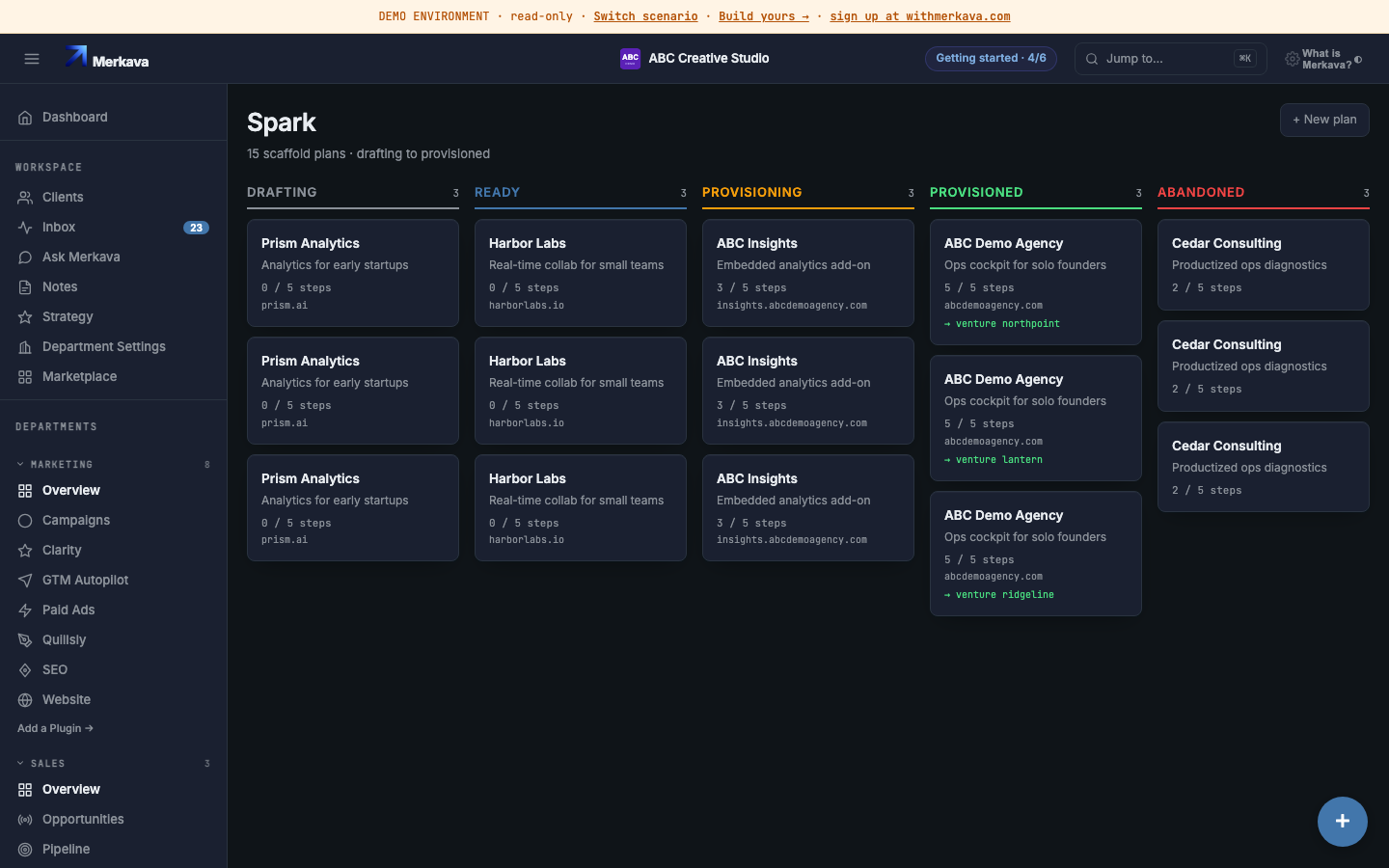
Spark takes one sentence and returns a live venture. Repo scaffolded, Railway service provisioned, domain registered and mapped, Webster marketing site online, Quillsly content queued, Relay widget embedded, Beacon watching. Ninety seconds from idea to URL. You still have to build the business — Spark handles everything that isn't the business.
The boring hour between idea and URL. Gone.
- Repo scaffold. A named GitHub repo with the stack you pick, CI wired, branch protection on, README populated from your sentence.
- Railway service. Spun up, environment variables templated, postgres optional, preview deploys on every PR.
- Domain + DNS. Spark checks availability, registers through the attached registrar, and maps the domain to Railway. Wildcards included for staging.
- Marketing site live. Webster builds a one-page site with hero, features, and waitlist form based on your sentence. You can edit it in place or throw it out.
- Content queue. Quillsly drops three pillar articles into the queue for the category Spark detected. You review, approve, ship.
- Support widget + watch tower. Relay embedded on the marketing site; Beacon starts watching for the brand across search the moment the domain resolves.
One sentence, a real product kernel.
A composite Spark run. Timestamps are illustrative — actual runs average 60–120s.
Three steps, one sentence each.
Type the sentence.
One line describing what you want to exist in the world. Spark extracts the category, likely stack, and naming hints.
Approve the plan.
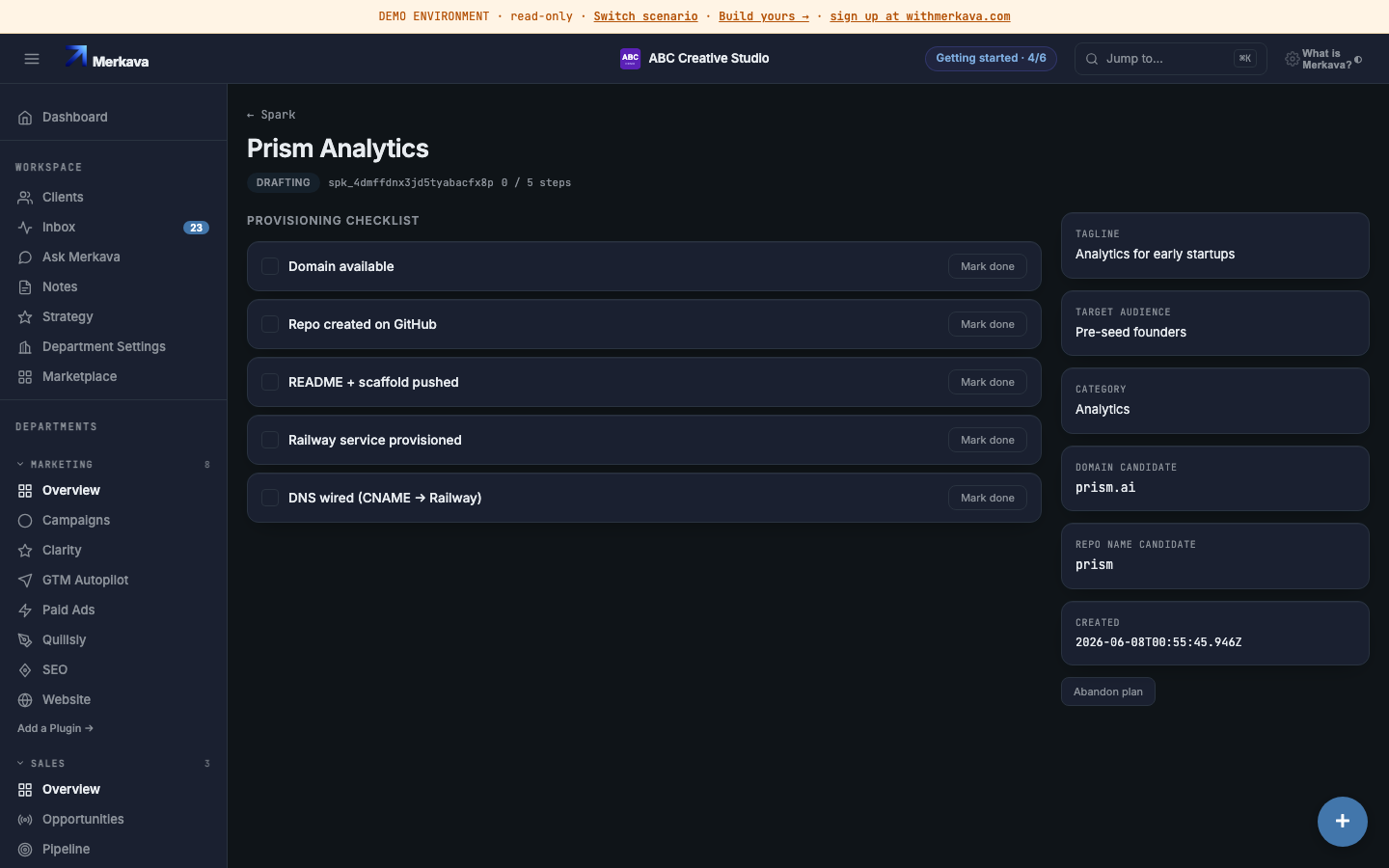
Spark shows the scaffold — repo name, stack, domain candidates, content topics — before provisioning. Edit anything; nothing ships until you click.
Open the URL.
In under two minutes, the venture exists. Repo, service, site, content, widget — live and wired to your Merkava workspace from minute zero.
Every Drive in the garage, actually.
Spark is the on-ramp. Once the venture is live, the rest of Merkava has something to watch, write for, publish to, and measure.
The questions venture-architects actually ask.
What kinds of ventures does Spark scaffold?
SaaS products, content sites, eCommerce stores, agency businesses, marketplaces, services-as-software — any business model where the early-stage scaffolding (entity structure, brand strategy, pricing, initial content, market positioning) is more pattern than novelty. Spark generates the scaffolding from a short briefing; you customize from there.
How is Spark different from starting from scratch in Notion?
Notion gives you blank pages. Spark gives you a venture skeleton wired into your Merkava workspace — entity records (founder, customers, market segment), pricing tiers (Marque), content pillars (Quillsly), brand voice (Atlas) — all populated from the briefing and ready to operate against. The first 80 hours of "set up the venture" is done before you start.
What does Spark generate from a briefing?
Initial pricing tiers (Marque records), 3-7 content pillars with starter keyword research (Quillsly), brand voice doc (Atlas), ICP definition (Prospector + Signals), outbound sequence skeleton (SAM via Quillsly), competitive landscape (OODA), brand kit primitives (logo color hints, typography suggestion). It's not finished work — it's the scaffolding you'd otherwise hand-build over a week.
Does Spark use AI to generate the scaffolding?
Yes — Forge generates the initial drafts from your briefing. But the output is structured operator data, not AI-bot conversation. Every pillar, every tier, every persona is editable in its native Drive. Spark's job is the cold start; the operator's job is direction.
Can I scaffold a venture for a client?
Yes. Each scaffolding instance creates a venture — agencies can scaffold one venture per client and operate it from one Merkava workspace. The venture is portable: the client can be granted access to their own venture inside Merkava, or you can export and hand off if they're moving to their own Merkava workspace.
What if Spark gets the venture shape wrong?
The scaffolding is a starting point, not a contract. Every output is editable. Spark surfaces WHY each piece was generated (which briefing answer drove which output) so you can iterate on the briefing without starting over. Re-scaffold cycles are fast — typically 5-10 minutes including review.
What does Spark cost?
Spark is a Tier-1 Drive at $19/mo standalone — the cheapest way to scaffold a new venture inside Merkava. It's bundled with the GROWTH executive ($199/mo, CMO + 7 specialists). Or hire the C-Suite at $599/mo. Most operators install Spark first, then add specialists as the venture matures.
Scaffold your next venture in a day.
Spark is live. Tier 1 · $19/mo. Spin up a new venture with name, audience, domain, repo, and a 5-step provisioning checklist. Connect GitHub + Railway from the cockpit and ship to a working homepage by Friday.