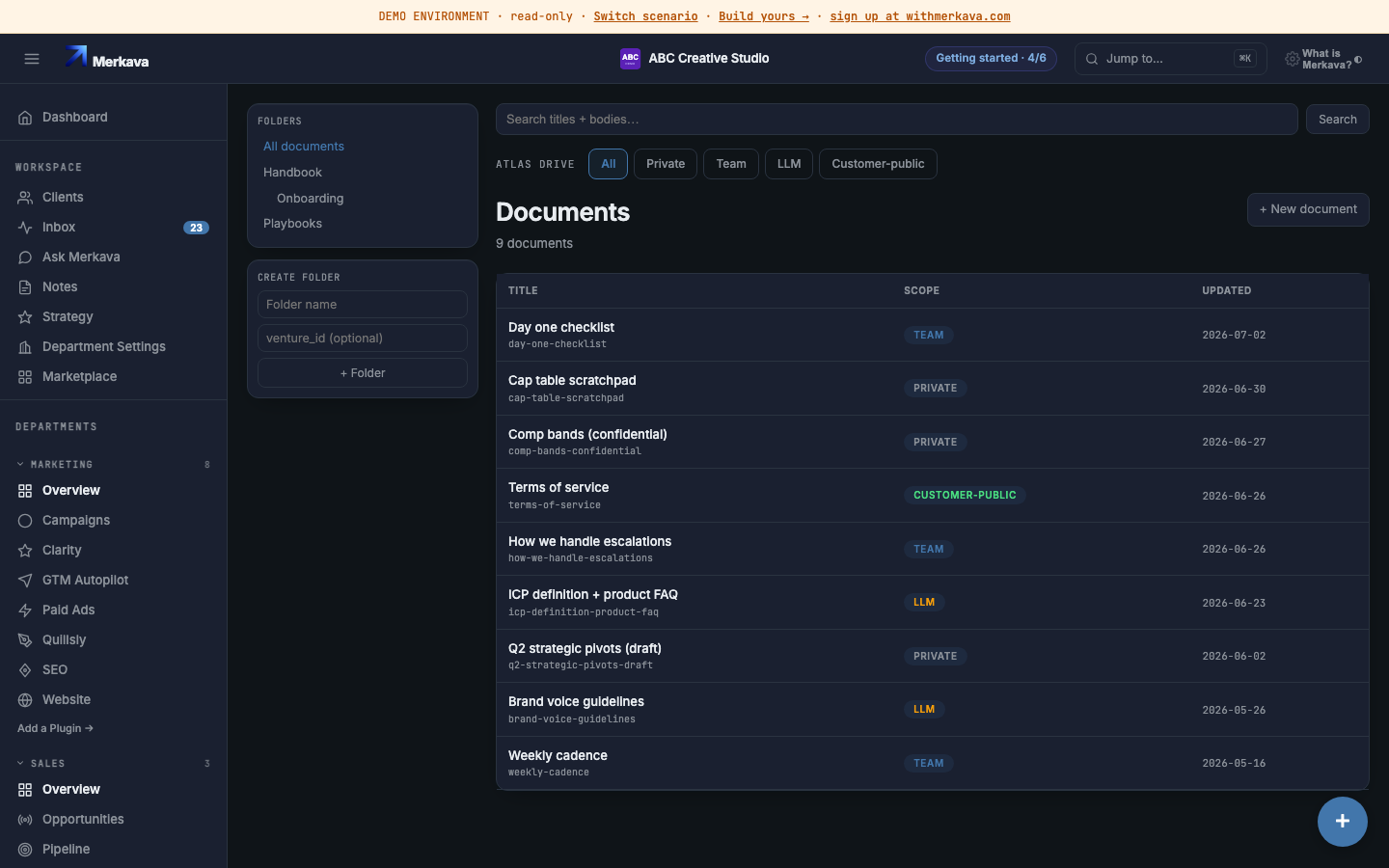
Atlas. Knowledge management that knows who can see what.
Atlas stores everything your team learns — playbooks, customer history, internal-only context — and tags each piece with an audience scope. Private, team-shared, AI-readable, or customer-public — the same record, four trust levels.
What Atlas does.
Four scopes per record
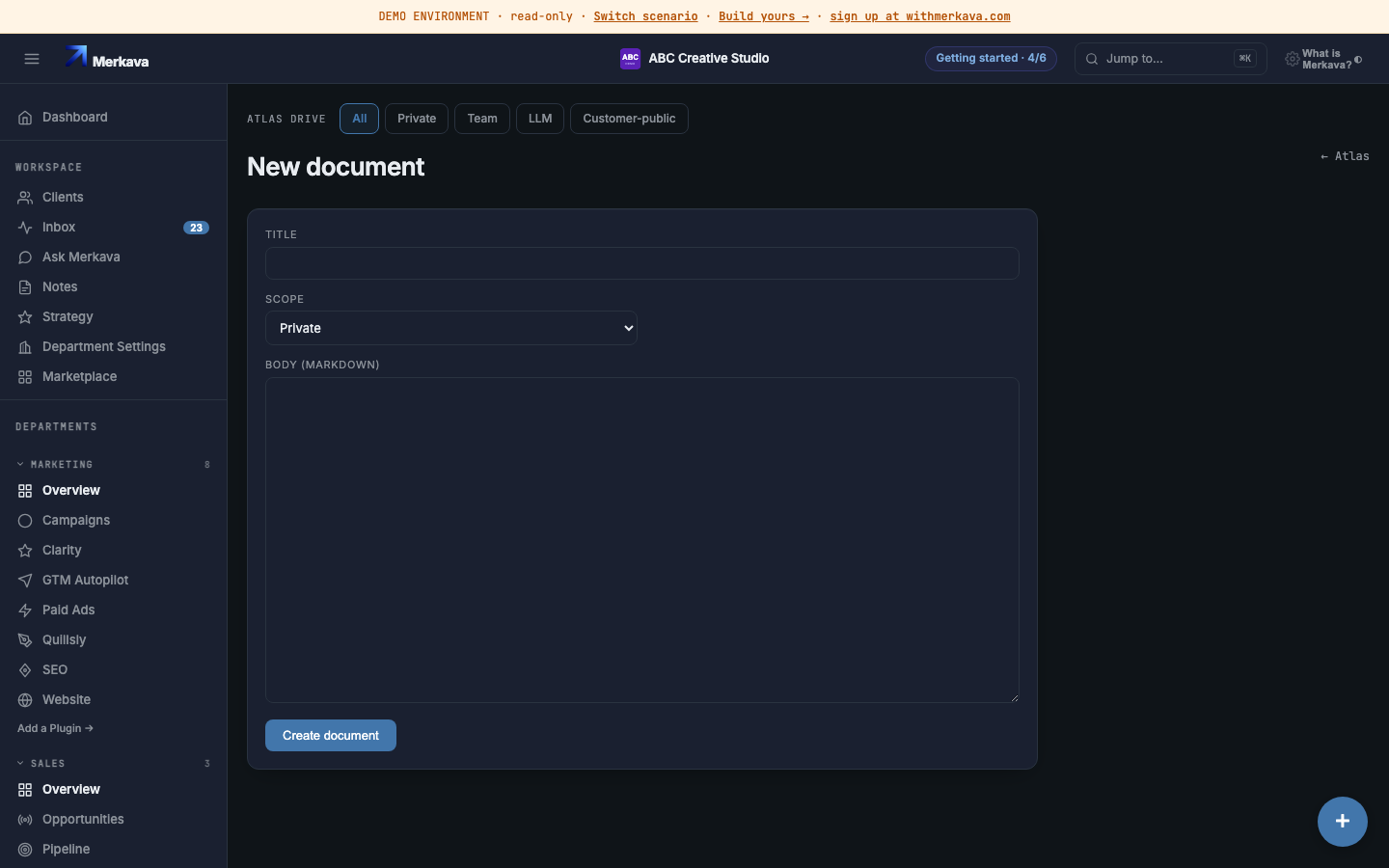
Each Atlas entry carries one of: private, team, llm-readable, customer-public. The scope determines who sees it — your team, your AI, or your customers — without managing four parallel systems.
Powers your AI engines
Forge (Merkava's AI engine) reads Atlas entries scoped llm-readable. Your AI executive team gets your real playbook, not a public-internet approximation.
Auto-publishes customer-public
Atlas entries scoped customer-public render to your /docs, /help, /resources URLs through Webster. One write, three places.
When to use it.
- You have institutional knowledge that lives in five-people's-heads or a sprawling Notion
- You want your AI executive team to know how YOUR business works, not just industry-average best practices
- You're publishing help docs / playbooks / customer-facing knowledge and need editorial governance
- You're in a regulated industry and need clear rules on what can be exposed externally
Integrates with.
Pairs well with.
Questions.
How is Atlas different from Notion or Confluence?
Atlas's scope tagging is built into the data model, not bolted on. The same entry serves your team, your AI, and your customers — without copying it three times. And Atlas is integrated into Merkava, so a Drive can read knowledge it needs to do its job.
Can my AI executive team read everything in Atlas?
No — only entries scoped llm-readable or higher. Private entries stay private even from Forge. This is by design: an executive that hallucinates from confidential records is worse than one with less context.
How do I import existing knowledge from Notion or Google Docs?
Atlas's import flow connects to your Notion workspace or Google Drive, classifies each document's suggested scope based on its location and content, and lets you review + accept in batch.
Where do customer-public entries appear?
They auto-render to a Webster-managed surface — typically /docs, /help, or /resources on your marketing site. The URL path is configurable per-entry.
Does Atlas work with Quillsly briefs and other Drives?
Yes. Quillsly pulls scoped entries from Atlas when drafting articles — your brand voice, your product facts, your style guide — so drafts cite from your knowledge, not generic training data. Other Drives (Beacon, Webster, Relay) also read from Atlas at appropriate scope tags. Atlas is the source of truth; the rest of Merkava reads from it.
How do permissions work?
Per-entry scope tags: private (operator only), team (operators + employees in Crew), llm-readable (Forge can read for grounding but not surface verbatim to users), customer-readable (Relay bot can quote), public (renders on Webster pages). You set scope on creation; Atlas enforces it everywhere downstream.
What does Atlas cost?
Atlas is part of the TECH executive bundle at $149/mo — CTO + scoped specialists, Atlas included. Or hire the whole C-Suite at $599/mo. Atlas can also be installed standalone as a Tier-1 Drive ($19/mo) for operators who only need the knowledge layer without the rest of TECH; see /pricing for current Drive subscription tiers.
Try Atlas in your Merkava workspace.
Hire one Drive or your full executive team.