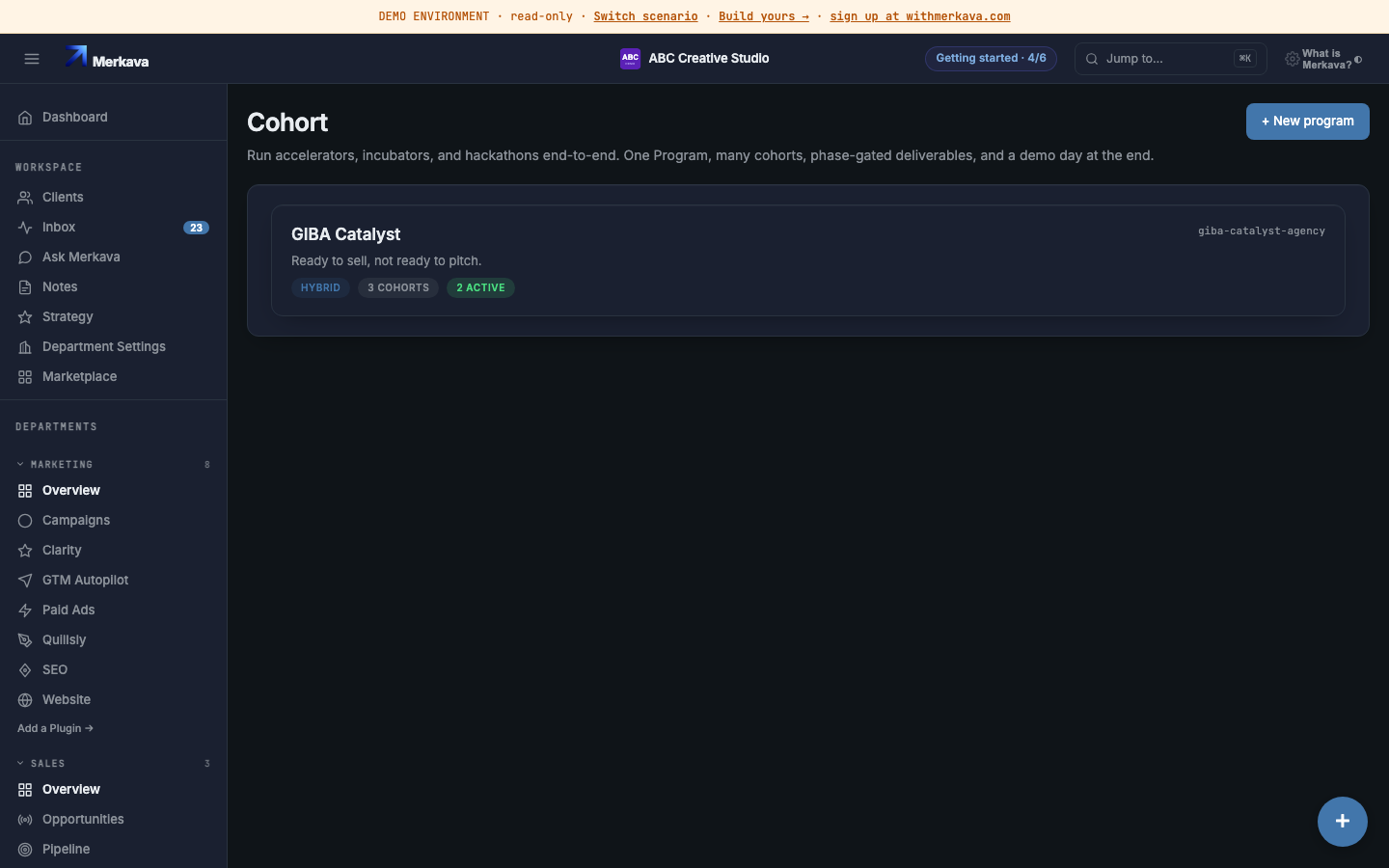
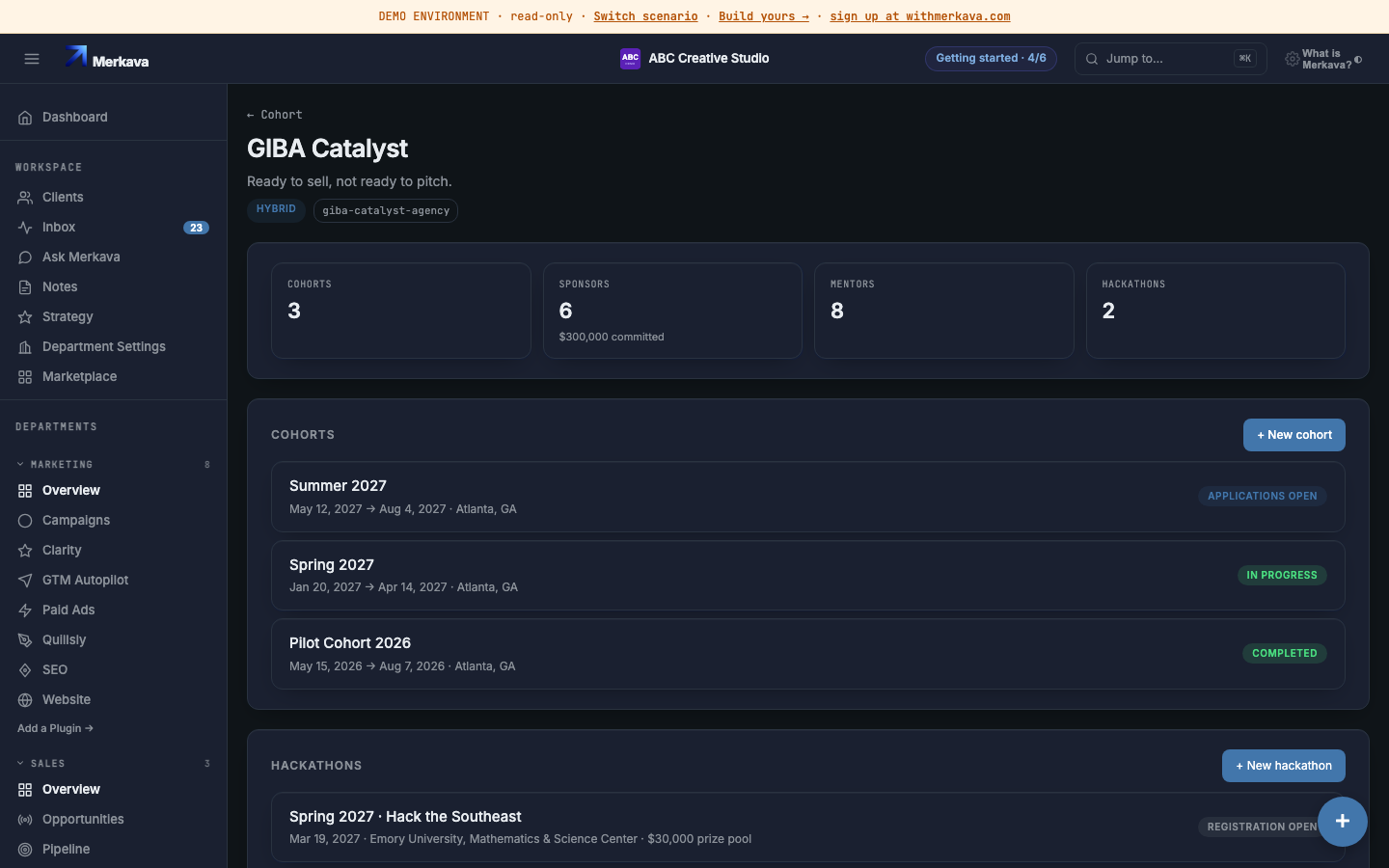
Cohort. Programs, accelerators, and demo days as a Drive.
Cohort runs the structured programs you produce — accelerators, incubators, fellowship cohorts, hackathons. Application intake, weekly cadence, mentor-pairing, demo day. The GIBA agent (Group Intelligence + Backbone Automation) handles the busywork.
What Cohort does.
Application intake + scoring
Public application page per cohort, structured scoring by reviewers, automatic deduplication of cross-cohort applicants. Replaces the Typeform-plus-spreadsheet model.
Weekly cadence built in
Each cohort week has a structured rhythm — agenda, attendees, recordings, action items. Cohort runs the meeting from the Drive surface so cohort members and program staff see the same source of truth.
Mentor pairing
Mentors register with their domains of expertise. Cohort matches them to participating teams based on declared needs. The pairing surface tracks office hours and outcomes.
GIBA agent for busywork
The GIBA agent (Group Intelligence + Backbone Automation) drafts cohort-wide updates, schedules check-ins, surfaces participants who've gone quiet, and flags applications worth a closer look.
When to use it.
- You run more than one cohort per year and the operations are eating your time
- You're launching a new program and want the structure to match what investors and participants expect
- You're evaluating Mighty Networks / Circle / Confluence and need something more program-aware
Integrates with.
Pairs well with.
Questions.
What kinds of programs is Cohort designed for?
Anything with a defined start and end, a scored application, a recurring weekly cadence, and a culminating event. Accelerators, incubators, fellowship programs, hackathons, executive education, founder retreats, and structured mastermind groups all fit the shape.
How does the GIBA agent work?
GIBA reads the cohort's shape (week number, declared goals, recent activity per team) and proactively does the obvious-but-tedious things: writing cohort updates, sending reminders, surfacing under-engaged teams to staff. It does not make program-direction decisions.
Can applicants apply to multiple cohorts at once?
Yes — Cohort dedupes by email + venture so an applicant applying to your Spring batch and your Fall batch shows up as one record with two applications. Reviewers see the cross-cohort context.
Is Cohort separate-billed from the rest of Merkava?
No — Cohort is part of the OPS executive bundle. Programs are typically run by operators who already have the rest of Merkava in place; the value is in the cross-Drive integration (mentor records in Crew, program docs in Atlas, demo-day registration via Webster).
How is Cohort different from Eventbrite or Coursera?
Eventbrite is a single-event ticketing tool. Coursera is async education. Cohort is the structured-program runtime — start date, scored applications, weekly cadence with the GIBA agent, demo-day capstone, and post-program tracking — all wired into your existing operator data (mentors are Crew records, sessions reference Atlas docs, demo-day registration runs through Webster).
How does the application scoring work?
You define a scoring rubric per cohort (custom criteria + weights). Reviewers score independently; Cohort surfaces inter-rater agreement and flags applications where reviewers disagree the most for committee review. Aggregate ranking is automatic; final accept/reject is human.
What does Cohort cost?
Cohort is part of the OPS executive bundle at $299/mo — COO + 7 specialists, Cohort included alongside Crew, Onramp, Centerline, Gauge, Ignition, and Relay. Or hire the whole C-Suite at $599/mo.
Try Cohort in your Merkava workspace.
Hire one Drive or your full executive team.