OODA
Observe. Orient. Decide. Act. OODA watches your competitors and your pipeline on the same surface, runs a structured recon loop continuously, and queues the playbooks to respond. Built on the decision doctrine pilots use; adapted for operators whose dogfight is a market, not a platform.
Competitive intel as a loop, not a dashboard.
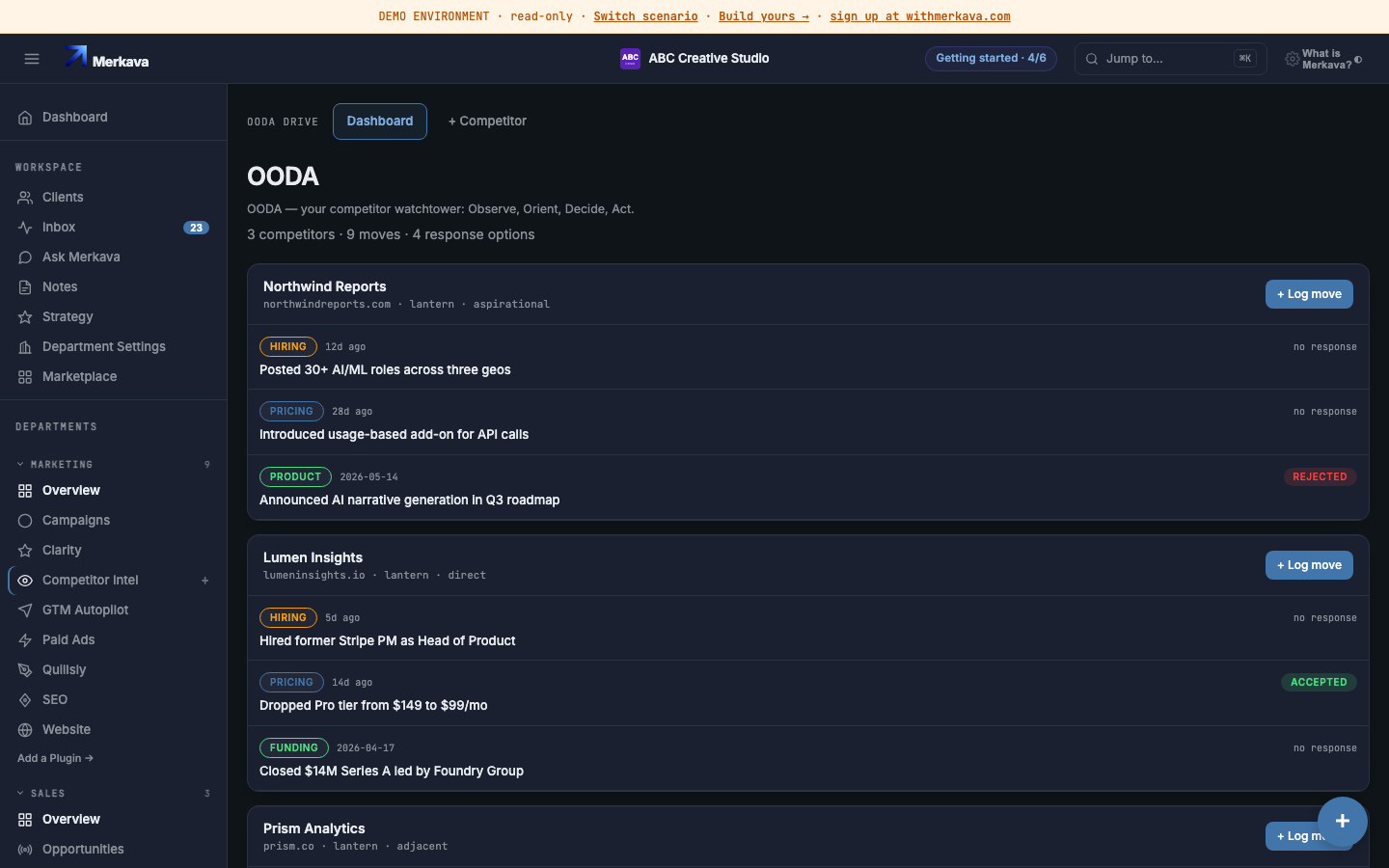
- Competitor watch. Landing pages, pricing, hiring, ad creative, release notes, social, SEC/Companies House filings. Fires when any surface changes.
- Pipeline recon. Deals in motion with competitor overlap flagged. If your prospect evaluates two competitors this week, you know before you get on the call.
- Response playbooks. When a competitor drops a pricing change or a feature launch, OODA queues a pre-drafted response — email, post, landing-page variant — for you to approve.
- Signal ranking. Not every change matters. OODA ranks by estimated impact on your pipeline, not by recency or noise.
- Audit trail. Every competitor move, every response, every deal outcome — in one searchable history. Post-mortems take minutes, not days.
O · O · D · A.
Watch the surfaces.
OODA monitors competitor domains, ad libraries, hiring pages, social, and public filings. Also your own pipeline — which deals are at risk, which are unopposed.
Rank what matters.
Every signal gets a score against your pipeline. A competitor's new landing page for the same ICP outranks a competitor's CEO tweet.
Queue the playbook.
For top-ranked signals, OODA drafts the response — pricing update, sales battlecard edit, retention call, or a Nitrous test — and routes it to your queue.
Ship the response.
Approve from the queue. OODA fires the action into the right Drive — Nitrous test, SAM post, CRM note, Webster edit — and tracks the outcome in the same record.
Feed the next observation.
Outcome becomes an observation for the next loop. Closed-won against competitor X means OODA weights your response playbook higher next time. Closed-lost means it gets scrutinized.
Daily recon brief.
Composite of OODA's recon brief. Actual UI ships with launch.
Recon feeds every surface.
The questions competitive-intel operators actually ask.
How is OODA different from Crayon or Klue?
Crayon and Klue are enterprise competitive-intel platforms priced for big sales teams — $30K–$80K+/year, and the value sits in the analyst dashboards. OODA is a Drive inside Merkava that runs the same competitor monitoring (pricing changes, feature launches, marketing claims, hiring signals, funding) without the enterprise wrapper. Designed for operators who need the intel but don't have a competitive-intel headcount.
What competitor signals does OODA track?
Pricing-page changes, new product / feature launches, marketing-site copy shifts, hiring spikes (job listings as a leading indicator of investment), funding events, content cadence (publishing velocity + topic shifts), and SERP movement on shared keywords. Configurable per competitor — track everything for top 3, lighter touch on the long tail.
Where does the data come from?
Public sources: marketing sites, pricing pages, product changelogs, hiring boards, GitHub repos (when public), funding announcements, news mentions, social posts. OODA crawls + diffs on schedule. No paid data brokers; everything is observable from public surfaces.
How is intel surfaced — alerts, digest, dashboard?
All three. Daily digest in the Merkava feed for routine changes. Real-time alerts (Slack or email) for high-priority events you flag — "alert me when CompetitorX changes pricing" or "alert me when CompetitorX hires a CMO." Dashboard view for browsing trend data over time.
How does OODA work with Prospector and Signals?
OODA tracks competitors. Signals tracks YOUR market — buying intent from prospects, market trend signals. Prospector tracks your pipeline. The three close the SALES intelligence loop: who's in the market (Signals), what your competitors are doing (OODA), where your deals stand (Prospector). The SALES executive ($99/mo) operates all three as a unit.
Can OODA write competitive battlecards?
Yes. OODA generates per-competitor battlecards (their positioning, pricing, strengths, weaknesses, common objections you'll face when buyers compare) and updates them as the underlying intel changes. Battlecards land in Merkava's resources tab — your sales motion always pulls the latest version.
What does OODA cost?
OODA is part of the SALES executive bundle at $99/mo — VP Sales + 3 specialists (Prospector, OODA, Signals), all included. Or hire the whole C-Suite at $599/mo. Standalone OODA pricing on the post-launch roadmap.
Watch the other guys.
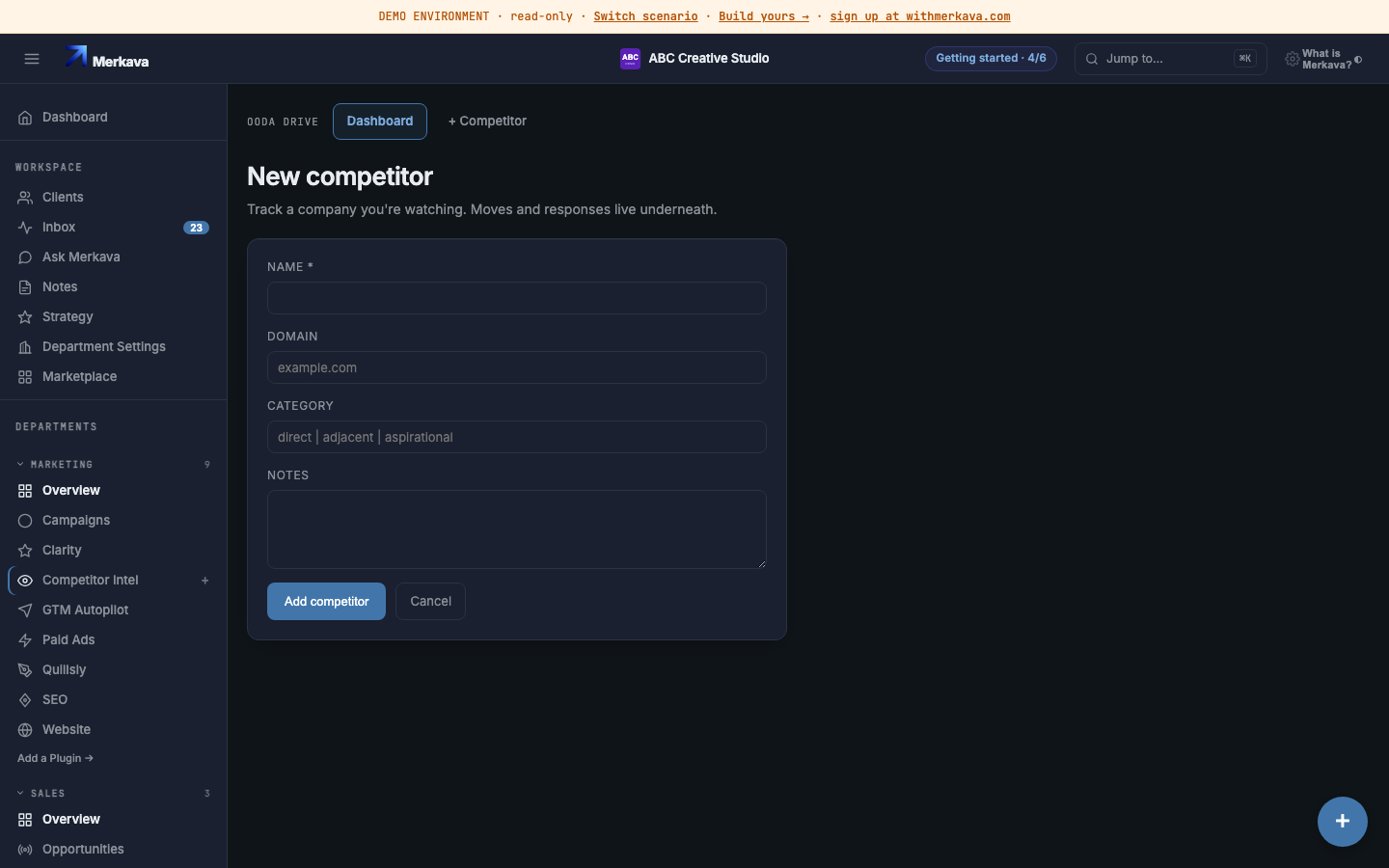
OODA is live. Tier 2 · $49/mo, bundled with the SALES exec hire ($99/mo) or C-Suite ($599/mo). Track competitor pricing, product, hiring, and marketing moves; draft response options; keep the loop tight. Human-observation in v1 — no scraping, no social listening.